
when community turns cult
When do we find ourselves in tight-knit community vs a functioning cult?

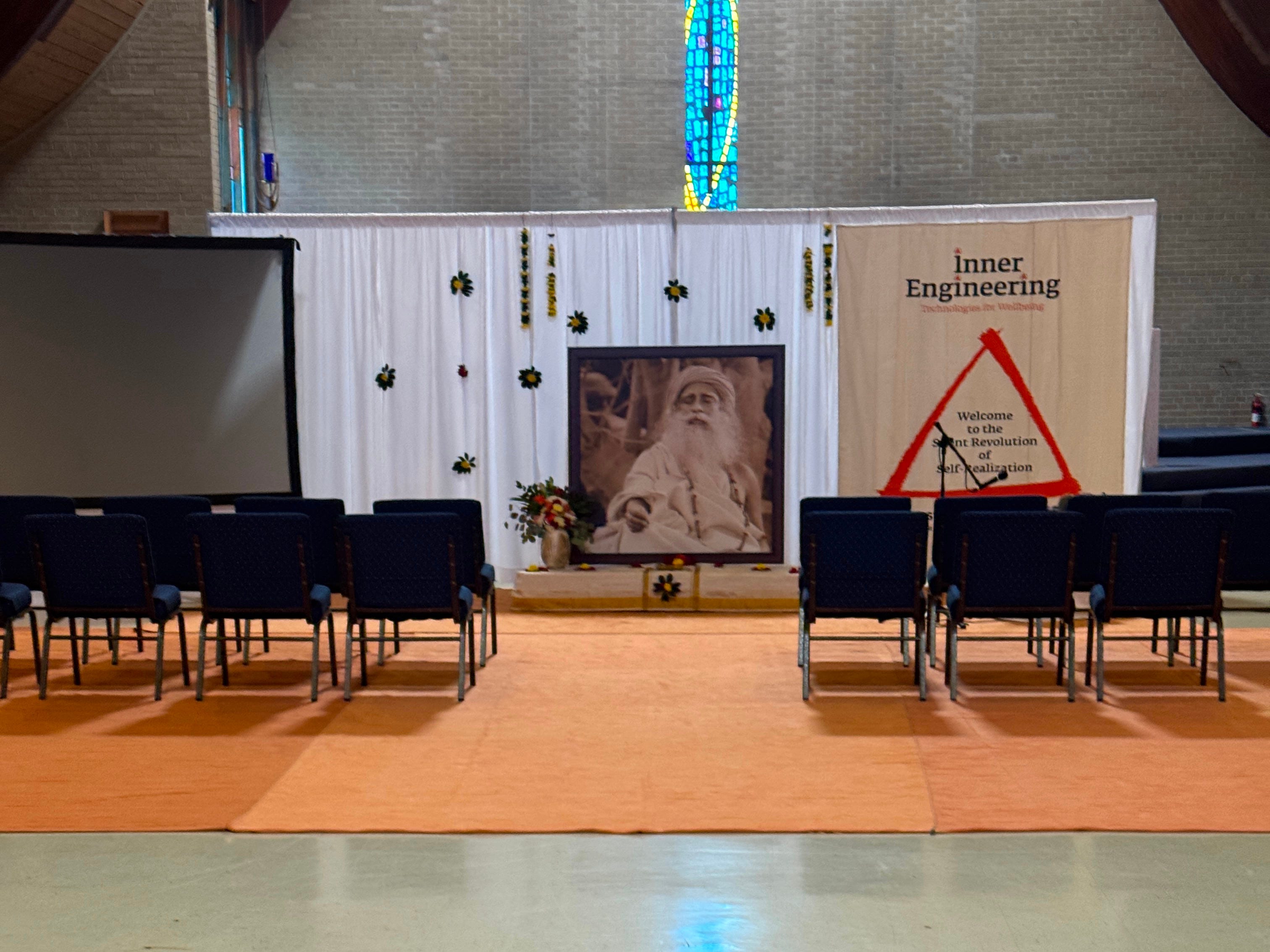
After accepting my uncle’s invitation to attend a 4 day “inner engineering” intensive program, I’ve defined a cult as having at least 95% the following elements:
The leader must be delusionally revered to the point of infallibility
Cultists must perform detailed rituals to show devotion to the leader
Authority and correct judgement always lies with more indoctrinated cultists
Cultists must convince themselves they know something that non-cultists don’t
Gradually require new followers to sacrifice materially in increasingly intrusive ways
Forbid speaking about what happens inside the cult while you’re outside the cult
Cultivate a fear of leaving; shame any form of voluntary exit
Discredit other beliefs
Promise exclusive, life-changing revelation tomorrow
Create compulsory consent in rituals by shaming non-participation
Cultists must prioritize the rules of the cult over their individual autonomy
Assign homework
The leader of the cult must profit tremendously
Cultists must constantly recruit
There must be more than 2 people
The belief must be tied to something partially supernatural
Answers to the impossibility of human existence must be offered
The program I attended consisted of long sessions sitting criss-cross apple sauce on the floor, listening to the cult leader Sadhguru word salad his sacrosanct opinions on life, death, love, ego, and more. This combined with an overly detailed yoga flow, invocation prayers, strict dietary regulations, and an overall obsession with a multi-millionaire, self-proclaimed guru made some alarms sound off in my mind and body.
But reading this list again bears striking resemblance to communities.
My school assigns homework, my teachers were “never” wrong, and my classmates and I had to recite a pledge of allegiance to a flag every morning.
Communists cadres ritualistically praise text from exclusively Marx, Lenin, and Mao, while bashing other imaginations on communism.
Cruise (a company I used to work for) enthusiastically hosted “Ask Kyle” weekly townhalls to rally behind our savior CTO, with technical trade secrets brewing a hush-hush excitement amongst engineers.
So when does a community (d)evolve into a cult? Before I answer this, a precursor question:
Why do cults exist?
The human spirit fundamentally needs to belong to community. Loneliness being physically unpleasant kept us alive, because the isolated, aloof members of the pack who braved the wilderness alone typically didn’t pass on their genes. Community was and still is survival.
Eons of environmental pressures accidentally gave us an advanced prefrontal cortex, replete with self-consciousness, the ability to plan far ahead, recognize patterns, and believe in unascertainable stories from other trusted humans.
Something else fascinating happened with our species once we become aware of ourselves. Not only did we need belonging, we began to construct an idea of purpose.
“Why am I here?”
Prehistorically, most humans probably would’ve answered “to make my tribe live as long as possible”. In ancient times, most humans probably would’ve answered “to make some greater power happy, so it will bless my tribe and we can live as long as possible”.
This impossible question has no correct answer. There is no universal reason why we are plopped down on earth, no cosmic plot to why we are here now, no benevolent deity that granted us privilege to be self-appointed masters of the world.
This leaves many of us modern apes pretty stumped.
What’s my purpose?
What’s my purpose?
What’s my purpose?
What’s my purpose?
What’s my purpose?!?
As an optimistic nihilist myself, that’s a question I believe every human has to subjectively answer for themself one day.
Terrifying right?
I don’t know when answers to these questions became central to human society, but I do know modern living has become unbearably devoid of meaning.
We aren’t living for the longevity of the tribe anymore. As community based living has withered and been replaced with a glut of western propaganda that we are only responsible for ourselves, many of us can’t answer this existential question just by looking in the mirror.

So why not relinquish the answer to a higher authority?
If I can’t convince myself of a purpose concocted fully by my own imagination, surely I can trust someone else to?
Sadhguru will.
Kyle Vogt will.
Jesus Christ will.
Vladmir Lenin will.
The Honorable Elijah Muhammad will.
Cults provide an answer to the impossible.
While our ancestors’ ancestors found meaning in their commitment to one another, cults try to fill that apparent gap in our hyper-individualized world.
They prescribe a meaning to a world utterly lacking one. They rationalize our infinitesimally unlikely existence. They give us a rubric to guide our lives, to reward our efforts in a universe that will eventually succumb to heat death.
Not all cults are bad. 1
The “inner engineering” Sadhguru teaches has objectively offered life changing healing and belief to hundreds of thousands. The Kriya yogic practice also doesn’t rally behind a shared demographic enemy; the only “enemy” is overcoming how you experience the world. Not a terrible idea.
Is believing in something better than believing in nothing?
As I’ve seen both extreme ends of the spectrum, I would rather be a devoted yogic worshiper to Sadhguru than a deeply apathetic, numb believer of nothing. The former can lead to idiosyncratic uncles. The latter can lead to incurably pessimistic school shooters.
Frankly, on my darker days, I almost envy people who can attach strongly to a greater belief system, spiritual or not. I almost get jealous of the eager co-worker who goes above and beyond on the job; I almost get jealous of the devout religious worshiper who prays 3 times a day; I almost get jealous of the full-fledged trumpet fighting to Make America Great Again by cursing minorities. Ok not so much that last one.
Let’s finish this detour;
Why choose cult over community?
So many of us have lost sight of what is and always has been and always will be the fundamental reason we wake up everyday; to help the village.
Community is committed to the uplift of the members.
Cult is committed to worshiping the leader.
Community builds interpersonal responsibility, a grounding interdependence.
Cult creates a egocentric, unidirectional dependence.
Community adapts to the changing needs of the members.
Cult forces a rigid top-down authoritarianism.
Community is discovered by the innocent bystander.
Cults actively recruit susceptible, directionless wanderers.
When we don’t have each other to wake-up next to, when we don’t have anyone who leans on us in times of need, when we don’t have a tribe we are actively sacrificing for, a cult can seem like a charming, next best option.
But let’s not get it confused.
Believing in one another is better than believing in just about anything.
We all need a voice in our head that explains why we get out of bed in the morning.
A cult leader can be that voice.
But the symphony of voices in your community based village can give a much more harmonious answer.
Choose wisely.
However, not all cults are good.
Our human desire to find meaning and belonging has historically been exploited to drive us towards the wrong ends. At the greatest scale, Nazi Germany convinced millions of humans to restore Aryan superiority to the world through war. At small scales, a culty workplace can convince hundreds of employees to stay mute about harmful business practices.